Document scale and structure
More than 8,000 pages varied in structure and terminology, requiring extraction and cleanup before retrieval.
 RANDY KRAKOWSKI
CASE STUDY / ENTERPRISE AI
Enterprise AI / Python / Document Processing / AI-Powered Retrieval
An internal AI chatbot that helps stakeholders search more than 8,000 pages of complex benefit documentation—and has surfaced spreadsheet discrepancies.
Deployed & In Active Use
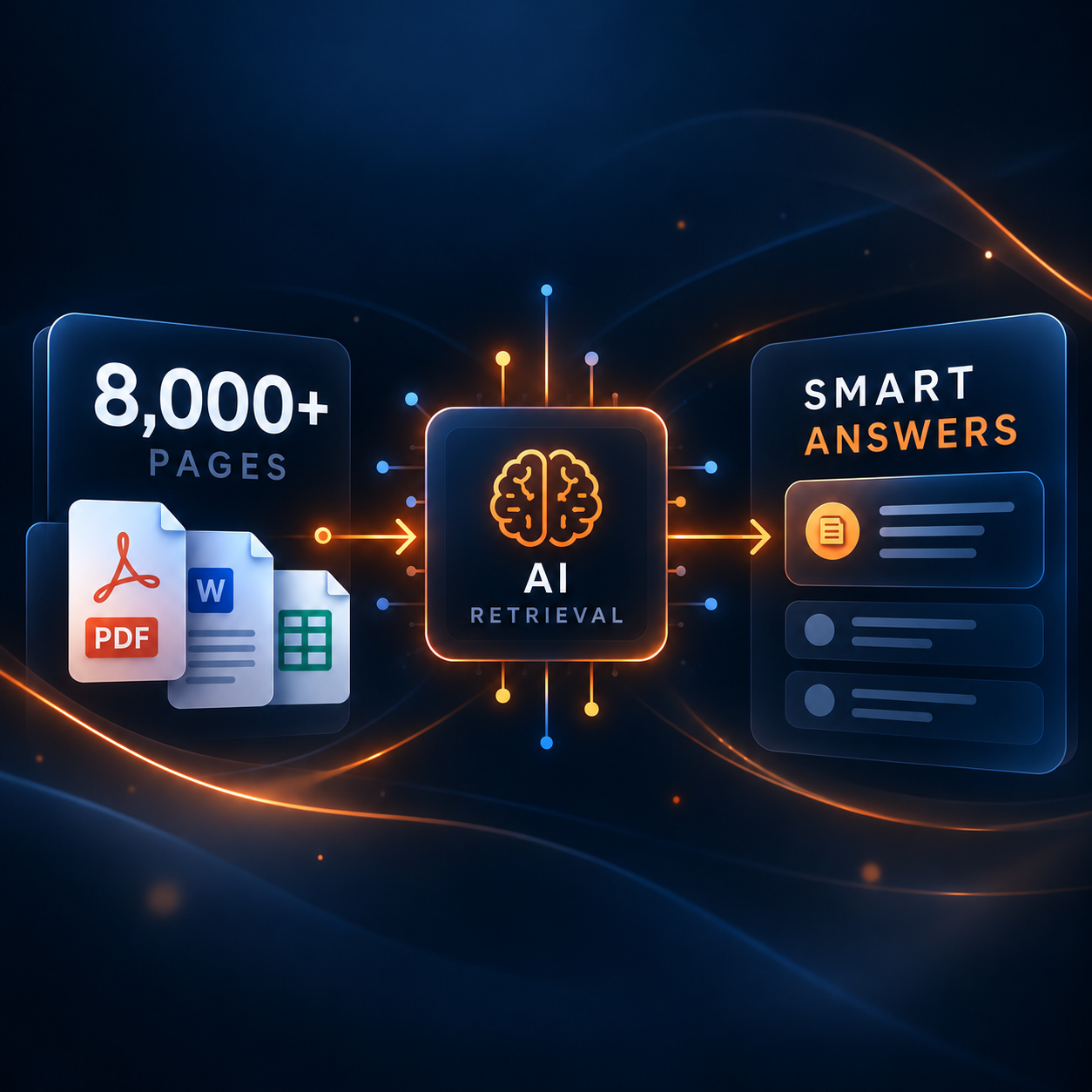
Built and internally deployed a conversational assistant for more than 8,000 pages of complex employee-benefit documentation.
Python-based extraction and cleanup prepare source content for question answering. In active stakeholder use, the chatbot reduces manual searching and cross-referencing, and has surfaced spreadsheet discrepancies; staff validate answers against the original documents.
Plan-specific details were difficult to locate and compare across a large, inconsistently structured source collection.
More than 8,000 pages varied in structure and terminology, requiring extraction and cleanup before retrieval.
Stakeholders searched lengthy documents and cross-referenced spreadsheets to answer plan-specific questions.
Spreadsheet entries could differ from source documents, making inconsistencies difficult to spot during manual review.
Python-based extraction and custom cleanup prepare the source documents for retrieval. The chatbot combines enterprise Azure OpenAI with retrieval-augmented generation (RAG) for natural-language question answering.
Stakeholders can ask plan-specific questions in plain language, then review responses against the original documents. Human validation remains part of the workflow, with source documents as the reference.
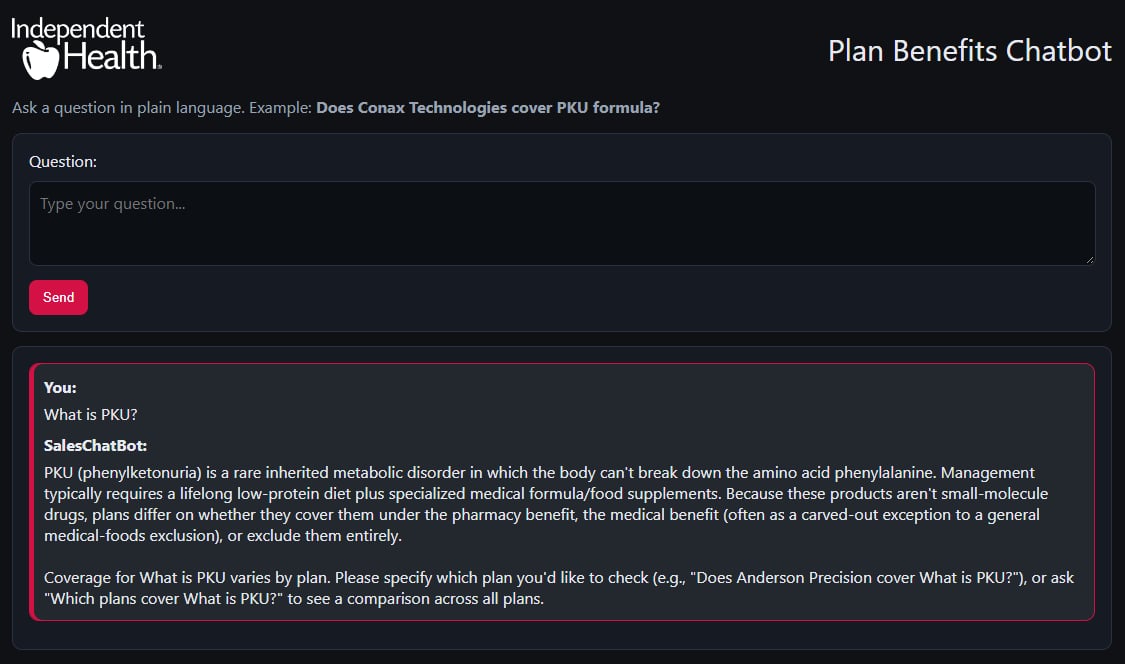
Built Python extraction and cleanup for inconsistently structured source documents.
Prepared a collection of more than 8,000 pages for information retrieval.
Stakeholders compare responses with source documents to assess accuracy and usefulness.
Deployed on the internal network for active stakeholder use.
Demonstrated outcomes: Internal stakeholders use the chatbot for benefit research. During real use, it surfaced spreadsheet discrepancies missed during manual review. Staff verify responses against the original documents.
Qualitative operational benefits: Conversational access reduces repetitive searching and cross-referencing. Formal time-saving, accuracy, and error-reduction metrics have not been established.
From 8,000+ pages of complex documentation to accessible, conversational answers: a deployed enterprise AI solution that accelerates research, exposes discrepancies, and keeps human validation central to the process.